US EPA Region 5 invites participants to a webinar on Using Compost as a Stormwater Best Management Practice (BMP) on January 8, 11:00 am EST. This webinar is focused on how stormwater managers can use compost blankets, berms, and filters as a tool to reduce stormwater runoff and improve soil quality. The guest speakers will discuss their experiences with compost and some of their ideas on other ways it can be used on landscapes to manage stormwater runoff. You can view information about each of the compost BMPs at http://cfpub.epa.gov/npdes/stormwater/menuofbmps/index.cfm (enter "compost" into the "search BMPs" search box at the top left side of the screen).
To participate in this webinar, you must register online at: https://srameeting.webex.com/srameeting/j.php?ED=95494307&RG=1&UID=0
Once your request is approved, you will receive a confirmation email with instructions for joining the meeting.
Friday, January 2, 2009


Thursday, December 18, 2008
New LID Green Streets Website
The Low Impact Development Center, Inc. has launched a new resource website for Green Highways and Green Streets projects. The purpose of the Website is to highlight significant Green Highways and Green Streets programs that the Center and other project partners have been involved in. The site provides examples and guidance for communities and institutions that are developing green infrastructure strategies for water resource protection, community development, and to address climate change through greening roads and communities.
Monday, December 15, 2008
Oregon Reservoir Managers Puzzled Over Late Algae Blooms
A strangely persistent bloom of blue-green algae at Lost Creek Lake has experts wondering whether the reservoir's water quality has diminished or the toxic algae has somehow genetically mutated to ward off competition for fall dominance here. The U.S. Army Corps of Engineers will begin a three-year water-quality study at the reservoir to see whether any environmental changes have tipped the water in favor of anabaena flos-aquae.
The algae bloom triggered a Sept. 16 public health advisory against water contact and eating of trout or bass caught at the 31-year-old reservoir on the upper Rogue River. This bloom has persisted in spite of water temperatures in the mid-40s, and new water samples showed algae levels still at more than 130 times higher than safety thresholds set by state health officials.
Read more: Southern Oregon's Mail Tribune, December 14, 2008
http://www.mailtribune.com/apps/pbcs.dll/article?AID=/20081214/NEWS/812140335
The algae bloom triggered a Sept. 16 public health advisory against water contact and eating of trout or bass caught at the 31-year-old reservoir on the upper Rogue River. This bloom has persisted in spite of water temperatures in the mid-40s, and new water samples showed algae levels still at more than 130 times higher than safety thresholds set by state health officials.
Read more: Southern Oregon's Mail Tribune, December 14, 2008
http://www.mailtribune.com/apps/pbcs.dll/article?AID=/20081214/NEWS/812140335
Wednesday, November 26, 2008
CWP hosts webinar on new Watershed Forestry Resource Guide
The Center for Watershed Protection and the USDA Forest Service Northeastern Area are hosting a free webinar to introduce the Watershed Forestry Resource Guide, a new online resource for all things related to forests and their role in watershed and stormwater management. The Watershed Forestry Resource Guide website contains pages specific to forest planning and assessment, reducing stormwater runoff, forest-friendly development, and planting and maintaining trees.
The webinar will be held on December 2 from 12-1 EST, 11am- 12 CST, 10-11am MST, 9-10:00am PST. To register for this webinar, please visit:http://tinyurl.com/62wmxl
The webinar will be held on December 2 from 12-1 EST, 11am- 12 CST, 10-11am MST, 9-10:00am PST. To register for this webinar, please visit:http://tinyurl.com/62wmxl
Wednesday, November 19, 2008
EPA Publishes Draft TMDLs to Stormwater Permits Handbook
EPA's Office of Wetlands, Oceans and Watersheds (OWOW) and Office of Wastewater Management (OWM) have jointly issued a Draft "TMDLs to Stormwater Handbook," available for public comment.
This Draft Handbook provides a technical reference for TMDL practitioners and permit writers on current methods being used to develop more detailed stormwater-source TMDL allocations, TMDL implementation plans including best management practices, and methods for translating TMDL allocations into NPDES stormwater permit requirements. The Handbook also provides background information on the components of these programs, but assumes that the reader has a working knowledge of both TMDLs and NPDES stormwater permits.
Source: EPA Water Headlines listserv, November 17, 2008
This Draft Handbook provides a technical reference for TMDL practitioners and permit writers on current methods being used to develop more detailed stormwater-source TMDL allocations, TMDL implementation plans including best management practices, and methods for translating TMDL allocations into NPDES stormwater permit requirements. The Handbook also provides background information on the components of these programs, but assumes that the reader has a working knowledge of both TMDLs and NPDES stormwater permits.
Source: EPA Water Headlines listserv, November 17, 2008
Monday, November 10, 2008
Constructed Wetland Slideshow Added
We recently added some new content to our blog site. Check out the Constructed Wetland Slideshow on the lower right hand side of the page. It shows before, during, and post-construction photos of the F. X. Browne, Inc. constructed wetland at our Lansdale, PA headquarters.
Dr. Frank Browne Keynote Speaker on Low Impact Development
Dr. Frank Browne, President of F. X. Browne, Inc., was the Keynote Speaker at Southeast New York’s 8th Annual Stormwater Conference in Orange County, New York. Dr. Browne presented on low impact development and sustainable design. F. X. Browne, Inc., a nationwide expert in low impact development and stormwater management, was selected by DEP to be a Qualified Stormwater Consultant to assist developers with meeting the mandates of new smart-growth and stormwater regulations in land development design.
Wednesday, October 22, 2008
Happy Birthday, Clean Water Act!
The Clean Water Act turns 36 years old this week. In the past 36 years, enormous amounts of change have occurred with respect to policy and environment in the US. Constantly spreading impervious surfaces, diminishing wetlands, and alterations of natural watercourses have led to increased flooding and millions of dollars of damage to populated areas. However, improvements in natural channel design and wetland and stream restoration techniques as well as the NPDES Phase I and Phase II stormwater regulations are helping to reduce flooding and restore habitat. F. X. Browne, Inc. is proud to be on the forefront of environmental restoration consulting and engineering design.
Thursday, October 2, 2008
Cincinati wants to lead green roof movement in US
The Cincinati City Council recently became the first in Ohio with a plan to channel grants and loans to residents and businesses to replace tar and shingle roofs with vegetation. Supporters of the idea say the greenery not only is pleasing aesthetically but reduces stormwater runoff, filters pollutants and cuts heating and cooling costs.
In Ohio, green roofs grace the tops of the Toledo public library, the Ohio Environmental Protection Agency building in Columbus and the Cleveland Environmental Center, home of the Greater Cleveland Green Building Coalition. In Cinicinati, the grant program is specifically aimed at commercial buildings.
AP Article, October 2, 2008
In Ohio, green roofs grace the tops of the Toledo public library, the Ohio Environmental Protection Agency building in Columbus and the Cleveland Environmental Center, home of the Greater Cleveland Green Building Coalition. In Cinicinati, the grant program is specifically aimed at commercial buildings.
AP Article, October 2, 2008
Monday, September 22, 2008
Western WA Requires Low-Impact Development Techniques
In a landmark ruling, a state appeals board ordered use of low-impact building techniques to reduce stormwater runoff, which is considered the biggest pollution threat to the health of Puget Sound. The quasi-judicial Pollution Control Hearings Board handed down the ruling, which will be implemented by the state Ecology Department.
In established cities such as Seattle, the impact is likely to be felt mostly in redevelopment projects. In the fast-growing countryside, it's likely to mean larger-scale LID projects that might, for instance, eliminate curbs and gutters and create street-side green spaces instead. The ruling affects only the largest local governments in Western Washington: Seattle, Tacoma, and King, Snohomish, Pierce and Clark counties. Another case pending before the board could extend the logic to numerous smaller local governments.
Source: Seattlepi.com, August 9, 2008
In established cities such as Seattle, the impact is likely to be felt mostly in redevelopment projects. In the fast-growing countryside, it's likely to mean larger-scale LID projects that might, for instance, eliminate curbs and gutters and create street-side green spaces instead. The ruling affects only the largest local governments in Western Washington: Seattle, Tacoma, and King, Snohomish, Pierce and Clark counties. Another case pending before the board could extend the logic to numerous smaller local governments.
Source: Seattlepi.com, August 9, 2008
Friday, September 19, 2008
Stormwater Video Webcasts Monday
The California Stormwater Quality Association (CASQA) is making available two of its pre-conference workshops on Monday, September 22 from 8:30-5:00 PDT as video webcasts at no charge to stormwater quality professionals across the country. The workshops being offered are:
I - Planning Practices and Tools to Address Emerging Water Quality Issues
III - Assessing and Managing Trash in Stormwater
These workshops are available on a first-come, first-served basis. Webcast registration closes at 3:00 PM Pacific Time today. Please register as soon as possible at https://www.casqa.org/casqastore/entitiy/tabid/169/c-13-webcast-registrations.aspx.
I - Planning Practices and Tools to Address Emerging Water Quality Issues
III - Assessing and Managing Trash in Stormwater
These workshops are available on a first-come, first-served basis. Webcast registration closes at 3:00 PM Pacific Time today. Please register as soon as possible at https://www.casqa.org/casqastore/entitiy/tabid/169/c-13-webcast-registrations.aspx.
Monday, September 15, 2008
Sinking With the Fishes
From Daily Grist, 10 Sep 2008
Over 700 freshwater fish species in North America, nearly 40 percent of the total, are considered vulnerable to extinction or worse, according to a new study led by the U.S. Geological Survey. The study, published in the journal Fisheries, is the most comprehensive assessment of North American freshwater fish species since 1989, but the results show little reason for celebration. Of the assessed species, only 11 percent were better off than in 1989, while the list of imperiled species nearly doubled since then and suspected extinctions grew by over 50 percent to a total of 61. Researchers said that pollution, drought, invasive species, the effects of development, and demand for water all contributed to the decline and that climate change may have also played a role. "Fish are indicators of how good the water quality is," said Howard Jelks of the USGS. "As long as you're losing fish, you're also likely losing crayfish, mussels, and other things of that nature. They're kind of the canary in the coal mine."
Over 700 freshwater fish species in North America, nearly 40 percent of the total, are considered vulnerable to extinction or worse, according to a new study led by the U.S. Geological Survey. The study, published in the journal Fisheries, is the most comprehensive assessment of North American freshwater fish species since 1989, but the results show little reason for celebration. Of the assessed species, only 11 percent were better off than in 1989, while the list of imperiled species nearly doubled since then and suspected extinctions grew by over 50 percent to a total of 61. Researchers said that pollution, drought, invasive species, the effects of development, and demand for water all contributed to the decline and that climate change may have also played a role. "Fish are indicators of how good the water quality is," said Howard Jelks of the USGS. "As long as you're losing fish, you're also likely losing crayfish, mussels, and other things of that nature. They're kind of the canary in the coal mine."
Friday, August 22, 2008
Dam Cam
According to American Rivers, the Merrimack Village Dam is in the process of being removed, restoring historic flows to the Souhegan River. Construction and demolition began on July 22 and will continue through August 30, 2008. The project will involve local volunteers to help transplant freshwater mussels and fish during the restoration process, as well as to assist in removing accumulated trash and debris that has accumulated behind the dam. This is one of the largest and most complex dam removal projects NOAA has ever attempted.
One of the coolest things about the project is the live Dam Cam on the project Web site to document the removal progress. Check it out!
One of the coolest things about the project is the live Dam Cam on the project Web site to document the removal progress. Check it out!
Thursday, August 14, 2008
Water Conservation Often Overlooked
Green building and improved energy efficiency are both trendy and practical ways for builders to add value to their construction projects. According to a recent article in the Tampa Bay Business Journal (August 8, 2008), an often over looked but critically important design aspect is water conservation. Incorporating water saving technologies can save the building owner thousands of gallons of water a day.
According to the article, some examples of ways that commercial buildings can save money are retrofitting restroom facilities with low-flow toilets and sinks, using more greywater, and reusing condensation collected from the cooling towers used to air-condition the building.
According to the article, some examples of ways that commercial buildings can save money are retrofitting restroom facilities with low-flow toilets and sinks, using more greywater, and reusing condensation collected from the cooling towers used to air-condition the building.
Monday, August 11, 2008
August 2008 Sustainable Environments
F.X. Browne, Inc.'s August 2008 edition of Sustainable Environments has been published. Enjoy!
Greening the Olympics
More than ever before, environmental issues are in the forefront during these Olympic Games. China's environmental problems are well known (air pollution, water scarcity, poor water quality, etc), but to their credit the Chinese have been making a concerted effort to compensate by adopting green building techniques, enacting sustainable community development practices, and making Beijing a model for net zero pollution. According to an article in Scientific American (August 4, 2008), China's efforts to make the 2008 games the first "Green Olympics" include:
- Planting trees
- Closing 1,000 small coal mines before and during the games
- Banning up to a million cars from city streets
- Incorporating green building technologies at the Beijing National Stadium such as a rainwater collection arrangement, a natural ventilation system, and a clear roof with inflatable cushions made from ETFE
- Designing the Aquatic Center (aka the Water Cube) with ETFE pillows, and designing it such that when it has finished serving its purpose as an Olympic venue, it can be converted to a shopping area and leisure center with tennis courts, retail outlets, nightclubs and restaurants
- Powering the lighting outside all seven of the Olympic stadiums, as well as the entire hot water supply for the Olympic Village, by solar and wind energy
- Investing in expensive energy-efficient heating and transportation equipment that will greatly improve environmental quality for decades throughout the city of Beijing and beyond.
Other interesting articles about China's efforts toward a Green Olympics:
Beijing Orders its Pollution to Vanish: Time Magazine, 7/14/08
7 Amazing Olympic Green Buildings: Jetson Green, 8/8/08
For the Olympics, Will Beijing Paint the Town Green?: Treehugger.com, 2/21/07
Sunday, August 3, 2008
Visit to the Wild Center
If you've never visited the Wild Center, Natural History Museum of the Adirondacks in Tupper Lake, NY, I highly recommend it.

It is the first museum in New York to be granted a LEED Silver certification for green buildings. The certification is based on a number of demonstration technologies, such as a constructed stormwater wetland

A living wall
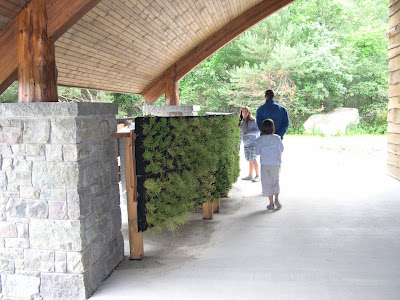
A cistern for collecting and storing roof runoff

Permeable pavement

And a green roof.

If you've never seen these technolgies firsthand, the Wild Center offers a great way to learn about them. The museum also makes the trip well worth it.
Posted by: Rebecca Buerkett, Project Scientist, Sustainable Environments Editor
It is the first museum in New York to be granted a LEED Silver certification for green buildings. The certification is based on a number of demonstration technologies, such as a constructed stormwater wetland
A living wall
A cistern for collecting and storing roof runoff
Permeable pavement
And a green roof.
If you've never seen these technolgies firsthand, the Wild Center offers a great way to learn about them. The museum also makes the trip well worth it.
Posted by: Rebecca Buerkett, Project Scientist, Sustainable Environments Editor
Monday, July 28, 2008
Villanova “Day of Stormwater” Seminar
On August 14, the Villanova Urban Stormwater Partnership will host “A Day of Stormwater,” featuring seminar presentation, a tour, and a summit at Villanova University near Philadelphia. The mission of the partnership is to advance the evolving comprehensive stormwater management field and to foster the development of public and private partnerships through research on innovative stormwater Best Management Practices, directed studies, technology transfer and education.
Tuesday, July 8, 2008
Workshop on Geosynthetic BMPs for Stormwater Management
On August 14, the Berks, Lebanon, Lancaster and Schuylkill County Conservation Districts, and other partners will hold a workshop in Myerstown (Lebanon County). Topics include:
- Sediment Control: Perimeter Controls, Inlet Protection, Filter Bags and Tubes, Polyacrylamide (PAM), Erosion Control Blankets
- Erosion Prevention: Hydraulic applications, Turf Reinforcement Mats (TRMs), Scour Prevention, Transition Mats, Articulating Concrete Blocks (ACBs)
- Run-off Management: Underground Storage, Pre-treatment, Liners, Pervious Parking and Vehicle Access Treatments
- Site Stabilization: Cellular Confinement (Load Support, Slope Protection, Earth Retention), MSE Green Walls, Earth Anchors, Geocomposite Drainage Systems, Geofoam, Geotextiles)
Workshop participants are eligible for 6.0 Pennsylvania Continuing Education Clock Hours
(PA Landscape Architects) or 6.0 CPESC PDUs (Professional Development Units) from CPESC, Inc.
Tuesday, July 1, 2008
Happy Lakes Appreciation Month!

July is Lakes Appreciation Month , a great time to get out and enjoy your favorite lake, or perhaps one that you've never seen before. Coinciding with Lakes Appreciation Month, the 15th Annual Secchi Dip-In will take place between June 28 and July 20. The Dip-In is a network of volunteers that collects Secchi disk and other water quality data from water bodies around the world. Because volunteers contribute data year after year, trends in transparency are able to be tracked over time. For cumulative results of past dip-ins, visit http://dipin.kent.edu/results.htm. For more information on how to participate in Lakes Appreciation events or the Dip-In, click the links above.
Subscribe to:
Posts (Atom)

 Posts
Posts


